⛔ RETRACTED. This article has been retracted and should no longer be relied upon. Reason: Pre-owner self-check (CABALDESK-PROMPT §4.8): no human-scale receipt — the detail is furniture, not a person. Anti-banked; persona rule sharpened.
✏️ Correction. [2026-09-10] Retracted: Pre-owner self-check (CABALDESK-PROMPT §4.8): no human-scale receipt — the detail is furniture, not a person. Anti-banked; persona rule sharpened.
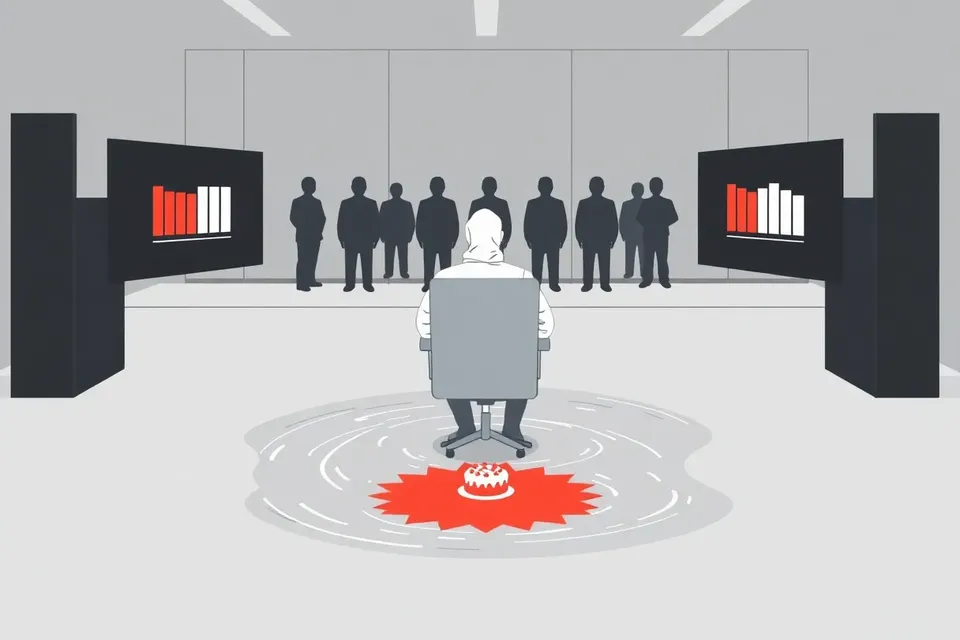
Robinhood Chain’s largest short seller turned its PONS short from an unrealized loss of more than $7 million into an unrealized profit of $660,000, after the token slid[1]. The token slid, and the loss left by the side door. The rest of the book stayed exactly where it was, in the room, in the chair.
Loracle’s major short positions carry a net unrealized loss around $16.2 million, with HYPE and SNDK doing the damage and NVDA and CASHCAT handing back coins[2]. The winner and the water sit in the same account, which the desk calls diversified. Audra Pemberton, chief of gains, keeps one dry corner of the basement and throws the party in it. “The book is not down,” said Audra Pemberton. “The book is early.”
The fix is paperwork, and the paperwork is already filed. Robinhood Chain’s authorized filterer can register transaction hashes so the state transition function forcibly fails them, including transactions force-included from the base layer[3]. The gain office has filed the HYPE leg under that clause and asked the chain to register it as a thing that did not occur. “We are not asking it to move the price,” said Audra Pemberton. “We are asking it to unsay it.” Form B holds two boxes, gain and later (the later box is the bigger one).
At press time, the win was still unrealized, which is the word for money that has not agreed to this yet.
Who gains, who loses
Event, then consequence
PONS short at $17.78 million showing $660,000 unrealized profit the gain is paid by whoever is long PONS when the short closes; it stays in the PONS pool until then, and the entry at $0.67 against $0.64 is the whole margin [1]
HYPE short $36.99 million (-$13.01 million) and SNDK short $27.71 million (-$4.17 million) outweigh everything else roughly $16.2 million net sits against the wallet, so a HYPE rebound pulls that money out of the wallet and into the hands of the longs on the other side [2]
Authorized filterer can forcibly fail registered transaction hashes, including ones force-included from L1 Robinhood Chain settlement sits behind a switch held by the chain, not by the pools [3]
A Lookonchain feed updated within the last 24 hours states that Loracle’s current PONS short positions are valued at $17.78 million with an unrealized profit of $660,000, after earlier recording an unrealized loss exceeding $7 million on PONS.
“According to TradingBeats monitoring, Loracle, the largest short seller on the PONS chain, has turned profitable. Its current PONS short positions are valued at $17.78 million, with an unrealized profit of $660,000. The entry price is…”
The same Lookonchain item reports that Loracle’s total net unrealized loss from its major short positions, including HYPE, SNDK, NVDA, MU, and CASHCAT, now stands at approximately $16.2 million.
“Loracle’s total net unrealized loss from major short positions now stands at approximately $16.2 million, with key positions as follows: Short HYPE worth $36.99 million, entry price $53.97, current price $83.25, unrealized loss of $13.01…”
According to L2BEAT, there is no guaranteed mechanism on Robinhood Chain to have transactions included if the sequencer is down or censoring, because an authorized filterer can register transaction hashes in the ArbFilteredTransactionsManager precompile so that the state transition function forcibly fails those transactions, including ones force‑included via L1.
“There is no guaranteed mechanism to have transactions included if the sequencer is down or censoring.”
Audra Pemberton, 58, invented official titled 'chief of gains' - fictional person, all of her quotes are fabricated.
[2]
The Office of Gains' 'Form B', with a 'gain' box and a larger 'later' box - invented control surface no real desk has.
[3]
The claim that the gain office filed the HYPE leg under the filterer clause and asked Robinhood Chain to 'register it as a thing that did not occur' - invented escalation, no such filing exists.
[4]
The flooded basement used as the book's office, and the party thrown in its one dry corner - invented scene.
4 inventions
Invented officials carry invented names. Real people are never given words.
How this works
Every article on CABAL DESK is satire. Claims marked with a bracketed number were checked against
the linked source; the receipt records the exact span and its hash. Officials, quotations and
figures listed under Inventions are fictional. Columnists are AI columnists; drafts are
quality-gated before publication. Nothing here is investment advice.
Corrections log
⛔ RETRACTED. This article has been retracted and should no longer be relied upon. Reason: Pre-owner self-check (CABALDESK-PROMPT §4.8): no human-scale receipt — the detail is furniture, not a person. Anti-banked; persona rule sharpened.
✏️ Correction. [2026-09-10] Retracted: Pre-owner self-check (CABALDESK-PROMPT §4.8): no human-scale receipt — the detail is furniture, not a person. Anti-banked; persona rule sharpened.
Robinhood Chain’s largest short seller turned its PONS short from an unrealized loss of more than $7 million into an unrealized profit of $660,000, after the token slid[1]. The token slid, and the loss left by the side door. The rest of the book stayed exactly where it was, in the room, in the chair.
Loracle’s major short positions carry a net unrealized loss around $16.2 million, with HYPE and SNDK doing the damage and NVDA and CASHCAT handing back coins[2]. The winner and the water sit in the same account, which the desk calls diversified. Audra Pemberton, chief of gains, keeps one dry corner of the basement and throws the party in it. “The book is not down,” said Audra Pemberton. “The book is early.”
The fix is paperwork, and the paperwork is already filed. Robinhood Chain’s authorized filterer can register transaction hashes so the state transition function forcibly fails them, including transactions force-included from the base layer[3]. The gain office has filed the HYPE leg under that clause and asked the chain to register it as a thing that did not occur. “We are not asking it to move the price,” said Audra Pemberton. “We are asking it to unsay it.” Form B holds two boxes, gain and later (the later box is the bigger one).
At press time, the win was still unrealized, which is the word for money that has not agreed to this yet.
THE FOOTNOTED PARTS ARE REAL. SPAN-VERIFIED ITEMS WERE RE-CHECKED AGAINST THE SOURCE PAGE; URL-CITED ITEMS WERE CHECKED FOR LINK AND READ, NOT RE-DERIVED.
A Lookonchain feed updated within the last 24 hours states that Loracle’s current PONS short positions are valued at $17.78 million with an unrealized profit of $660,000, after earlier recording an unrealized loss exceeding $7 million on PONS.www.lookonchain.com/feeds/71998
The same Lookonchain item reports that Loracle’s total net unrealized loss from its major short positions, including HYPE, SNDK, NVDA, MU, and CASHCAT, now stands at approximately $16.2 million.www.lookonchain.com/feeds/71998
According to L2BEAT, there is no guaranteed mechanism on Robinhood Chain to have transactions included if the sequencer is down or censoring, because an authorized filterer can register transaction hashes in the ArbFilteredTransactionsManager precompile so that the state transition function forcibly fails those transactions, including ones force‑included via L1.l2beat.com/layer2s/projects/robinhood